
Victorian Pool & Spa Fence Rules: A Plain-English Guide
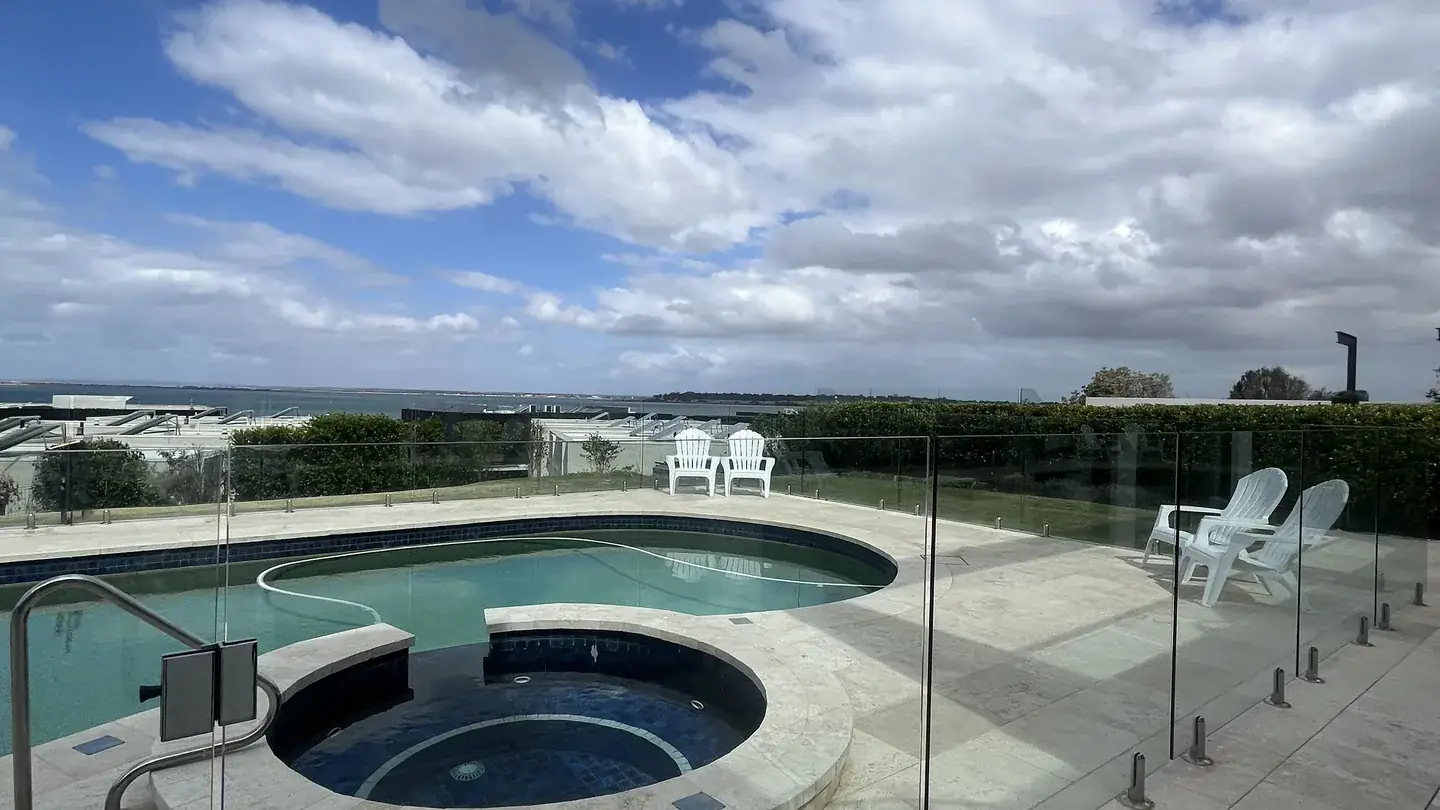
In Victoria, any pool or spa that can hold more than 300mm (30cm) of water must be surrounded by a safety barrier, registered with your council, and inspected every four years. Pass, and you get a Form 23 certificate that you then have 30 days to lodge. Here is the whole thing in plain English.
The short version
- The rules apply to anything holding more than 300mm (30cm) of water, including spas, hot tubs and inflatable pools.
- A barrier must be at least 1.2m high, with no gap over 100mm (10cm) underneath it.
- There must be a 900mm non-climbable zone outside the barrier and 300mm inside it.
- Gates must be self-closing and self-latching, must not open toward the pool, and the latch must sit at least 1.5m off the ground unless it is shielded.
- Boundary fences used as part of the barrier must be at least 1.8m high.
- You must lodge your certificate within 30 days, and repeat the whole cycle every four years.
The exact standard your pool is judged against depends on when it was built. That catches a lot of people out, so it is worth getting right before anyone comes out.
Does this apply to my pool or spa?
If it holds more than 300mm (30cm) of water, yes. That is a low bar, and it is deliberately low. It captures far more than the in-ground pool most people picture:
- In-ground and above-ground swimming pools
- Spas and hot tubs, including portable ones with a lockable hard cover
- Indoor pools
- Inflatable and blow-up pools, if they hold water to that depth
- Bathing and wading pools
People are most often surprised by two of these. A portable spa on the deck is still a spa in the eyes of the regulations. And a large inflatable pool that stays up over summer is not exempt just because it is temporary.
Which rules apply to your pool: the three date bands
This is the part almost every guide skips, and it is the reason two neighbours with near-identical fences can get different results.
Victoria does not judge every barrier against today's standard. It judges your barrier against the standard that applied when your pool or spa was installed, or when the barrier's building permit was issued. There are three broad bands:
- Installed before 8 April 1991. The oldest set of requirements applies. These barriers are generally the ones with the most surprises in them, because a lot has been renovated around them since.
- Installed between 8 April 1991 and 30 April 2010. Judged against AS 1926.1-1986 (for barriers approved from 8 April 1991 to 31 October 1994) or AS 1926.1-1993 (from 1 November 1994 to 30 April 2010).
- Installed from 1 May 2010. Judged against AS 1926.1-2007 (for barrier permits issued 1 May 2010 to 30 April 2013) or AS 1926.1-2012 (for permits from 1 May 2013).
So "my fence was fine last time" and "my neighbour's is the same as mine" are both reasonable things to think, and both can be wrong. If you know roughly when your pool went in, tell me when you book and I can tell you which set you are being measured against before I arrive.
One rule worth calling out on its own: since 1 May 2010, an outdoor pool or spa must not have direct access to the pool area through a door from a building. If your back door opens straight into the pool enclosure and the barrier dates from then, that is a structural problem, not a small fix.
The barrier, in numbers
For barriers under the current standard, these are the figures I am actually measuring on the day:
- Height: at least 1.2m. Measured from the finished ground level on the outside of the barrier.
- Gap underneath: 100mm (10cm) or less. Measured to compacted, stable ground. Loose soil or mulch that a child could scrape away does not count as ground level.
- Gaps between vertical members: no more than 100mm. That covers palings, rods and wires.
- Horizontal elements: at least 900mm apart on any barrier under 1.8m high. Horizontal rails are a ladder to a determined toddler, so the standard spaces them out.
- Mesh and perforated panels: if the holes are bigger than 13mm, the barrier has to be at least 1.8m high, because small fingers and toes turn mesh into a climbing surface.
- Boundary fences: at least 1.8m high where they form part of the barrier, with a 900mm non-climbable zone at the top.
The non-climbable zone, explained properly
The non-climbable zone is the single most misunderstood part of the rules, and the one that most often turns a "my fence is fine" into a fail.
It is not about the fence. It is about everything near the fence.
There must be a 900mm clear zone on the outside of the barrier, measured as an arc from the top of the barrier, and a 300mm clear zone on the inside. Anything in those zones that a child could get a foot or a hand onto counts as a climbing aid.
Things I regularly have to ask people to move:
- Pot plants, planter boxes and garden beds built up against the fence
- Pool pumps, filter housings and hot water units
- Outdoor furniture, benches, eskies and toy boxes
- BBQs and woodpiles
- Retaining walls and rockeries that step up toward the barrier
- Tree branches and sturdy shrubs
The barrier itself also has to be free of footholds. Projections or indentations in the non-climbable zone need to be 10mm or less deep. If they are deeper than that, they have to sit at least 900mm below the top of the barrier, at least 900mm above the ground, and at least 900mm apart.
The good news: this is the cheapest category of fail to fix. Most of it is half an hour with a wheelbarrow.
Gates: where most pools fail
If your pool is going to fail, the gate is the most likely reason. Every requirement here exists because a gate is the one part of a barrier designed to open.
- It must not open toward the pool. Gates have to swing away from the pool area.
- It must be self-closing, from any position. Open it to ninety degrees, open it to five degrees, let go, and it has to come back and engage the latch on its own.
- It must be self-latching, automatically, on closing, and it must not be able to be reopened without deliberately releasing the latch.
- The latch release must be at least 1.5m above ground level, or else shielded, with the shield covering a radius of at least 450mm around the release and no opening in it bigger than 10mm.
Hinges sag, springs weaken, and gates drop over time. A gate that latched perfectly two summers ago often will not now. Before your inspection, do this: walk to the gate, open it about 100mm, and let it go. Then do it again from wide open. If it does not close and click both times, every time, that is your fail, and it is usually a hinge adjustment or a new spring rather than a new gate.
And the one that costs people a certificate more than any other: a gate propped open with a brick or a pot on inspection day. If it is propped, it is not compliant, no matter how well it works.
Windows and doors
Where a wall of the house forms part of the barrier, the openings in that wall are part of the barrier too. Windows that open into the pool area have restricted opening requirements, and doorsets are assessed as part of the barrier. This is another area where the date your barrier was permitted changes what applies, so it is worth flagging when you book if a window or door of the house faces your pool.
Register, certify, lodge: the paperwork
There are three separate obligations here and they trip people up in that order.
1. Register the pool with your council
If your pool or spa has never been registered, that is step one and it sits with you as the owner, not with me. Your council holds the register and it is what triggers your reminders.
2. Get the barrier inspected and certified
Once your barrier passes, you are issued a Form 23 Certificate of Pool and Spa Barrier Compliance. That is the document that proves compliance, and it is valid for four years from the date it is issued.
3. Lodge it with your council within 30 days
This is the trap. The certificate is not the finish line, lodging it is. You have 30 days from the date of issue to lodge it with your council.
Miss that window and the council cannot accept it. Not "will charge you a late fee": cannot accept it. You need a whole new certificate, which means a new inspection and a new fee, for a barrier that already passed. I have seen people pay twice for no other reason than a certificate sitting on the kitchen bench for five weeks.
So when I hand yours over, lodge it that week.
The four-year cycle, and selling
Every pool and spa in Victoria runs on a four year cycle. Certificate issued, lodged within 30 days, then a fresh inspection and a fresh certificate four years later. Your council will generally send a reminder when yours is coming due, but the obligation sits with you as the owner whether the reminder arrives or not.
Selling changes the timing. A current Form 23 is required for the Section 32, the vendor's statement, so it has to be in place for the contract of sale, and a buyer's conveyancer will ask for it. If you are thinking about listing, get the inspection done before the campaign starts rather than during it. A barrier issue found in the middle of a settlement is a stressful and expensive way to discover your gate needed a new spring.
The most common reasons pools fail
In rough order of how often I see them:
- The gate does not self-close or self-latch reliably. Sagging hinges, tired springs, a latch that catches only sometimes.
- Climbable objects in the non-climbable zone. Pots, pumps, furniture, woodpiles, garden beds.
- Gaps. Under the barrier where ground has eroded, or between panels and posts.
- Boundary fence height. An 1.8m fence that has settled, or has a retaining wall raising the ground on one side.
- The gate being propped open on the day.
Notice what is not on that list: almost nothing here requires a new fence. The overwhelming majority of fails are adjustments and tidying, which is exactly why the order you do things in matters so much.
How to pass first time
You do not have to guess at any of this. Before I come out, I send a plain-English pre-inspection checklist and review a few photos of your barrier and gate. Anything obvious gets flagged then, while it is still a five minute job, instead of on the day when it becomes a re-inspection.
That is the whole reason most of the pools I inspect pass on the first visit. It is also why there are no surprise re-inspection fees here: one visit, one fee, one certificate. If something genuinely does need fixing, you get a clear report with photos showing exactly what and where, and a re-inspection from $100 +GST once it is sorted.
A first inspection is from $270 +GST and includes your Form 23 within 48 hours when your barrier is compliant.
What a barrier inspection does not cover
Worth being straight about the scope. A barrier inspection assesses the safety barrier: the fence, the gate, the non-climbable zones, and any walls, windows or doors forming part of it. It is not a structural or condition report on the pool shell, the plumbing, the pump or the water quality. If you are buying a property and want to know what the barrier will cost to bring up to standard before you sign, that is a pre-purchase inspection, which is a different job.
Written by Leanne Burnett, Qualified Pool Barrier Inspector (IN-PS 100069). Last updated 22 July 2026. Figures in this guide are drawn from the Victorian Building Authority's pool and spa safety barrier requirements. It is general information rather than legal advice, and because the standard that applies depends on when your barrier was built, the only way to know where yours stands is to have it assessed.
Good to know
Victorian pool rules FAQs
Book locally
Pool inspections by town
The rules above apply to every pool in Victoria. Pick your town to book.